This blog post was originally written by the Dutch user Asterope @ www.myhorsez.com/nl/ and translated by HorseloverMargaux
Breed spotlight: Haflinger
We are all familiar with this beautiful creature. In 2011, this breed was added to the Dutch server of My Horsez, that’s 15 years ago! With their beautiful white manes, they steal the hearts of players! Even people who are not horse experts often recognise this beauty. We are, of course, talking about the Haflinger!
Origin of the Haflinger:
The Haflinger is originally from South Tyrol, Italy's northernmost province. It owes its name to the place where the breed originated: Hafling. Due to the steep mountains and hard ground, farmers at the time were looking for a sturdy and strong horse. This became the Haflinger! The progenitor of this lovely breed was a cross between a mountain horse and an Arabian. The name of this stallion was “Folie 249”. By crossbreeding with Arabian blood, the Haflinger acquired its distinctive characteristics: a large, expressive head and strong legs.
The breed quickly became known throughout the rest of the world. It is a versatile breed that can be used in many equestrian sports. In addition to being a versatile breed, the Haflinger also has a very pleasant character. This makes it a very popular breed!
Character and nutrition:
Haflingers are strong, not easily rattled and stand firmly on their feet. They are often a bit stubborn, though. The breed is considered a horse for the whole family and is popular with people of all ages. They are easy to care for and can stay outside almost all winter and summer. Due to its mountain origins, the Haflinger needs less feed than other horses. This also means that they are more prone to becoming overweight if fed the wrong food or too much food. Laminitis is also a potential risk.
The appearance of the Haflinger:
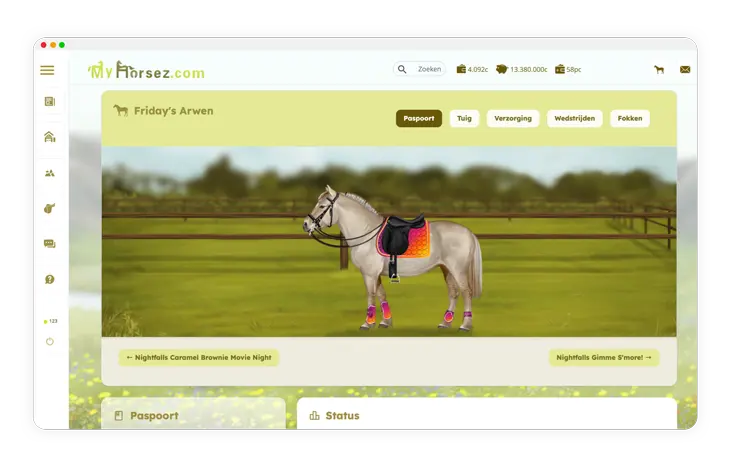
Almost everyone is familiar with the Haflinger. It is a strong, intelligent horse with a recognisable appearance. Thanks to the coat colour of this breed, you can quickly tell that you are seeing a Haflinger! The only colour that the Haflinger is allowed to have is chestnut. The intensity of the colour can vary from light to very dark. They have few markings and the mane must be white or flaxen. Together, this is called “flaxen chestnut”. You often see Haflingers with the familiar thick manes. Some Haflingers even have double manes. Braiding, such as the running braid, is therefore a lot of work with this breed! Although the Haflinger is not tall (135 - 155 cm), it is considered a horse breed, not a pony breed. This is mainly due to its robust body structure.
Fun facts about the Haflinger:
On My Horsez, the Haflinger always has two copies of the flaxen gene.
The branding mark formerly used for the Haflinger was an Edelweiss. The Edelweiss is a small flower that grows in the Alpine meadows. This flower also contained the letter ‘H’ for Haflinger. Because of its branding mark, the Haflinger was also formerly known as the Edelweiss pony.
The Haflinger has a twin brother: the Avelignese. This breed is often considered to be the Italian Haflinger. They both originate from the same region but show slight differences. For example, the Avelignese is slightly larger and sturdier than the Haflinger.
Thank you for reading this blog! What do you think of the Haflinger?
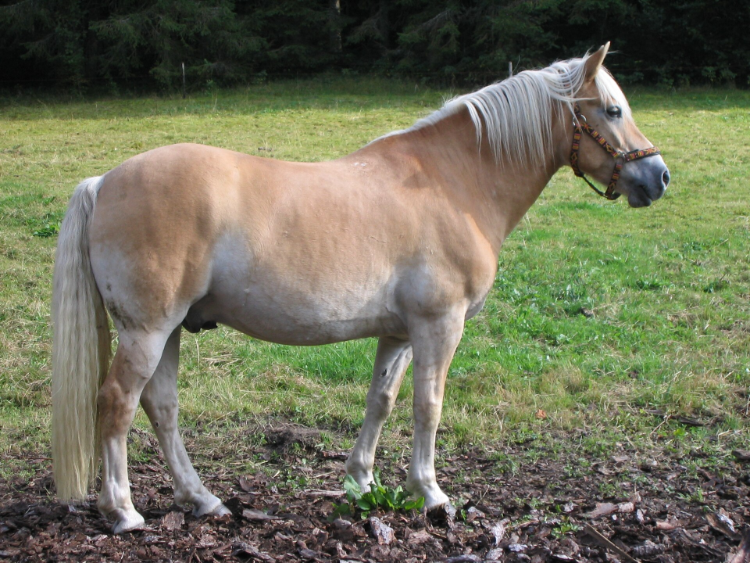
Source: Flominator, CC BY-SA 3.0, via Wikimedia Commons