This blog post was written by: HolyCow
Please note: Please note: This topic can be quite complex. To fully understand this blog, I strongly recommend that you have (re)read the previous blogs.
In the
previous blog, I talked about non-mendelian inheritance of genes. This blog focused mostly on some of the ways in which different alleles or different genes could interact with each other. In this blog however, we will look more at genes at a chromosomal level.
X-linked inheritance
In earlier blogs, I mentioned that each pair of chromosomes contains two chromosomes which in turn contain the same genes (but possibly different alleles with each gene). This is largely correct, and is known as
autosomal inheritance. There is however an exception: sex chromosomes. These include the X chromosome and the Y chromosome. Most male mammals have one X and one Y chromosome. Most female mammals have two X chromosomes. The presence of an Y chromosome usually results in an animal developing male characteristics. The Y chromosome is also considerably smaller than the X chromosome.
The genes located on the X and Y chromosomes differ from one another. Y chromosomes have a few genes that are not on the X chromosome. The Y chromosome is also considerably smaller than the X chromosome, so as a result it is also common for genes to be found only on the X chromosome. This is when
X-linked inheritance happens.
With recessive alleles, it essentially comes down to whether all available X chromosomes carry that allele or not. In male horses, which have only one X chromosome, the presence of the recessive allele on the only one X chromosome is sufficient to produce a particular phenotype, because in that case, áll available X chromosomes in that individual carry the recessive allele. In female horses, there are two X chromosomes, and in the case of X-linked recessive inheritance usually both of these X chromosomes need to carry that allele for the trait to be fully expressed.
This is due to how recessive mutations work: Often (but not always!), a recessive mutated allele means a defect allele with a loss of function, while the wildtype allele is fully intact and working as it should be. In male mammals who carry one broken/recessive X-linked allele, there is no working X-chromosome left, while in female mammals with one mutated X-linked allele there will still be one X-chromosome which dóes work. Even so, female mammals might still have a mixed phenotype due to
X-inactivation: In this process, one of the X chromosomes in a cell is deactivated, meaning there is a chance the broken X chromosome is the only one left and thus parts of the body will show the mutated phenotype. A famous example of phenotypes caused by X-inactivation are tortoiseshell cats!
With dominant alleles, often only one allele is needed in both female and male mammals to express the trait.
There are no examples of X-linked inheritance on MyHorsez, but there are in real horse coat genetics: Brindle, BR1. The BR1 mutation is not just about coat colour, but also coat texture. More important for this blog however: BR1 is also X-linked and incompletely dominant. In the case of X-linked incomplete dominance, the intermediate phenotype is mainly found in female animals. After all, males generally have only one X chromosome and therefore cannot be heterozygous for an X-linked gene.
In this case, mares with the genotype BR1/n have stripes with unusual coat texture giving them a brindled appearance. Meanwhile, mares BR1/BR1 have sparse manes and tails, but do not have the unusual coat structure. In stallions/geldings, the genotype will be BR1/-. ‘-’ is used rather than +/n/br1 here because the second allele is missing, compared to the mare where the second allele is simply the wildtype/standard allele. As a result, they do not have a ‘normal/wildtype’ allele left, and these stallions and geldings will also have the sparse mane and tail with no unusual coat structures.
Genetic Linkage
Until now, we’ve mostly discussed genes as if being separate entities, inheriting independent of each other. Now, this is (simplified) the case when genes are on different chromosomal pairs. However, there are thousands and thousands of genes, but only 32 pairs of chromosomes, so naturally: Lots of genes share a chromosome.
As already explained in the first genetics blog, a chromosome can contain multiple genes, and a parent passes on one chromosome from the chromosome pair.
Suppose you have a chromosome 1, which contains the genes 1, 2 and 3, with alleles A, B and C respectively. On the other chromosome of that chromosomal pair, you have alleles a, b and c respectively.
Because only one chromosome is passed on at a time, either the chromosome with alleles A, B and C is passed on, or the chromosome with alleles a, b and c. It is therefore not the case that the different genes on a single chromosome are passed on independently of one another.
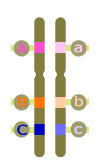
However, this does not mean that linked genes are always passed on together. In this example, having read the previous explanation, you might say: Either “A, B, C” ór “a, b, c” is passed on. But never “A, B, c”.
But this actually isn’t true: the chromosomes of a chromosome pair can exchange sections of DNA:
crossing over.This usually occurs during a phase of cell division in which a cell has twice the normal number of chromosomes for reproduction (meaning the cell has two of each chromosome pair / each chromosome pair within a chromosome has doubled)
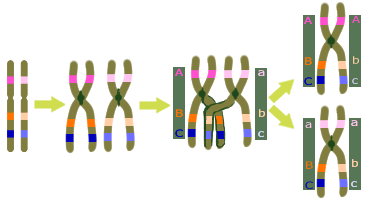
The closer two genes are to each other on a chromosome, the greater the chance that the alleles of these genes will still be separated by the process of crossing over. (Meaning you pass on “A, B, c” or “a, b, C” instead of “A B C” or “a b c”) The closer they are together, the smaller the chance that the genes will ever be separated.
As with X-linked inheritance, there is no linked inheritance on MyHorsez, but there are examples of linked inheritance in horses in the real life world: The KIT gene, which includes the Tobiano allele, and Extension (Black/Bay vs Chestnut) are both located on chromosome 1.
Suppose a stallion is heterozygous for both ‘Ee’ and ‘TOto’. The genotype could be (excluding other genes like agouti or dilutions) written down as: “E TO / e to”. The alleles ‘E’ and ‘TO’ are therefore together on one chromosome, as are the alleles “e” and “to”. Imagine this stallion is crossed with a solid chestnut mare (“e to / e to”, thus she would always pass a “e to” genotype)
The expectation is that the stallion will either
- pass on ‘E’ and ‘TO’, and thus produce an offspring with “E TO / e to” causing the black tobiano phenotype.
OR
- pass on ‘e’ and ‘to’, resulting in an offspring with “e to / e to”, causing a solid chestnut
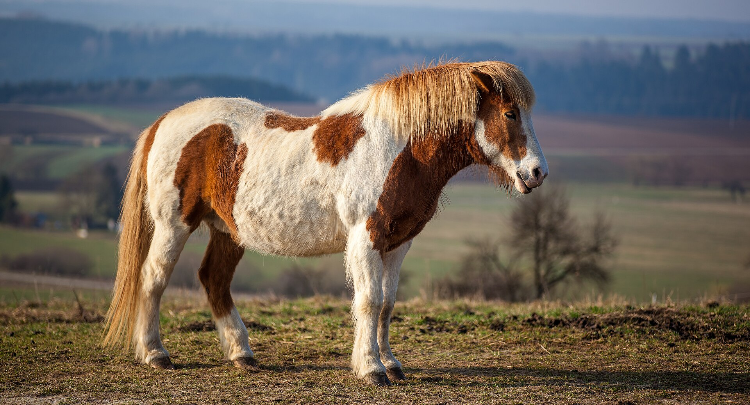
However, due to crossing over, it is also possible that the stallion passes on the ‘TO’ and ‘e’ alleles, resulting in offspring with a different genotype, like “e TO / e t”, resulting in a chestnut tobiano. This probability is, however, lower than that of the stallion producing a black tobiano or a solid chestnut, due to the linkage of the genes.
 Source: Michael Apel, CC BY-SA 3.0, via Wikimedia Commons