This blog post was written and translated by: HolyCow
There are a great many horses in the world that are used for riding. Among other things, rein aids are used to make it clear to the horse what we expect of them. Bridles can convey these signals to your horse. They do this by applying pressure behind the ears, on the chin, jaw and nose. However, the main task often assigned to a bridle is to keep the bit stable, with the pressure of the bit in the mouth being the clearest signal. But this isn’t strictly necessary, and there are many horses that don’t particularly like the pressure in their mouths. That’s why this blog highlights a few bitless bridles! Of course, it’s important to discuss with professionals what might be a suitable option for your horse, but I thought it would be interesting to provide a good introduction to the different types of bitless bridles (and to show that a poor result with one type doesn’t mean your only option is a bitted bridle)
Low-leverage bridles
One of the best-known types of bitless bridles is the
sidepull. The design is fairly simple. Essentially, it is a standard bridle as we are used to seeing in english disciplines, with a high noseband. However, instead of the reins being attached to a bit, they are attached to rings on either side of the noseband. This makes steering straightforward. The nose is an easy point from which to control a horse: when you move it, the head moves with it. And when the head moves, the body follows almost instinctively.
A sidepull therefore acts primarily on the nose, and to a lesser extent on the jaw, behind the ears and the chin.
Another commonly used bitless bridle is the
jaw-crossed bridle. With this type, a rope or (synthetic) leather strap passes under the head on both sides, from the jaw area (next to the throatlatch, or in place of the throatlatch) to the noseband diagonally opposite. This creates a cross under the head. The strap passes through a small ring attached to the noseband. From there, it can be attached to the reins.
Due to the design of this bridle, in addition to some pressure on the head, there is also considerable pressure on the jaw and behind the ears. Depending on where the cross is positioned under the head, pressure is also exerted on the chin.
The
chin-crossed bridle resembles the jaw-crossed bridle: in this design, the extra straps are both attached to the nose. The strap crosses over to the other side of the nose, passes through a ring there, and can then be attached to the rein.
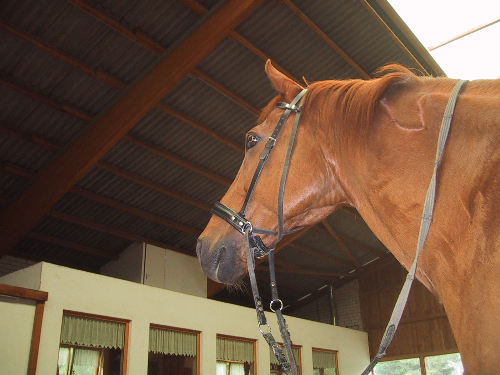 Source: Hü, Public Domain, via Wikimedia Commons
Leverage & Hackamores
A notorious type of bitless bridle is the
hackamore, due to the typical image people have of it. The hackamore, however, is a fairly broad category of bridles. There are even definitions that classify the sidepull as a type of hackamore. Generally speaking, however, a hackamore refers to a type of bridle that exerts pressure through a slight lever effect.
A classic hackamore design is the
bosal. A well-fitting, sturdy noseband is essential here. In fact, the name ‘bosal’ refers primarily to this noseband. The noseband is traditionally made from braided ‘rawhide’, meaning untreated leather. Unlike with most bridles, this noseband does not sit tightly against the nose with ‘just’ two fingers’ width of space between it and the nose, but curves much more loosely around it. The reins, traditionally made from braided mane/tail hair or alpaca hair (though commercially often made from standard nylon cord), are usually attached just below the nose.
As a result, when a rein aid is given towards the back, the sturdy noseband exerts light pressure on the bridge of the nose and behind the ears. If a chin strap is added, pressure will also be exerted on the jaw.
The bad reputation for hackamores comes mostly from the
mechanical hackamore. This is also a broadly defined term; in a wide sense, it refers to any bitless bridle featuring iron shanks between the noseband and the reins. This creates a lever effect, the strength of which depends on the size of the shanks. The pressure is directed primarily at the nose, but also significantly on the chin and behind the ears.
More specifically, this often refers to a type of bridle with very long shanks, which merge into an iron noseband, with soft but firm material covering the bridge of the nose.
Here, however, we are more likely to see the
English hackamore, which does indeed have shanks (though often shorter than those on the aforementioned mechanical hackamore), but features a standard leather noseband. Due to the very long shanks used in this type of bridle, the lever effect is very pronounced, and pressure builds up quickly: even if you, as the rider, give a normal aid, your horse may perceive this as a fairly strong aid. As a result, they do provide a great deal of control over your horse and are therefore a popular choice amongst riders with strong horses who prefer not to use a bit. This type of bitless bridle is also permitted during international FEI show jumping competitions and is being used there with increasing frequency.
A very popular type of (‘mechanical’) hackamore is the
wheel / star / flower hackamore. One of the reasons this type of hackamore is so popular, particularly amongst dressage-oriented riders, is that its has a somewhat luxurious design. It features a large ring attached to the noseband, with various sections arranged like the spokes of a wheel, a star, or the petals of a flower. (Hence the name) With this type of wheel-style bridle, the leverage effect is limited and depends on which section you attach the rein to. Attaching it closer to the horse’s nose means that, due to the rotational action of the wheel, there is greater leverage. Some of these wheel-style hackamores feature an extra ring beneath the wheel itself, which acts like a shank and can be used to make the hackamore even stronger. This type of hackamore is still less powerful than the average mechanical or English-style hackamore.
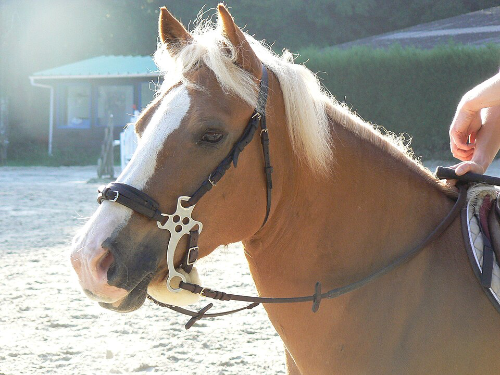
A horse wearing an English-style hackamore
Source:olgalday, CC BY-SA 2.0, via Wikimedia Commons
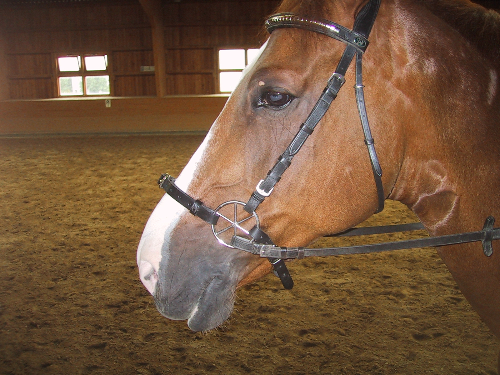
A wheel-hackamore. Because the adjustment is set slightly past the middle spoke, the bridle is set slightly tighter than if the rein had been positioned a little further back.
Source: Immerwiederfreitags, CC BY-SA 2.0 DE, via Wikimedia Commons
Bear in mind that no two bitless bridles are the same. Small differences, such as a leather strap that has been moved slightly, removed or added, can mean that the pressure distribution is different. A bitless bridle may also incorporate several different techniques. It’s important to find out what your horse finds comfortable!
Have you ever ridden bitless? How did you and, perhaps more importantly, your horse experience it?


 MutedUser
Yggdrasil
says:
MutedUser
Yggdrasil
says:
 I prefer to ride her bitless it just fits both of us way more