This blog post was written and translated by: HolyCow
Nowadays, we have a great many different studbooks, registers and the horse breeds that have emerged from them. A very long time ago, things were different: studbooks for a specific breed, as we know them today, were virtually non-existent back then. And it was certainly not a given that a breed originating in one country would be carefully bred on the other side of the world to preserve those specific breed characteristics.
A ‘breed’ arose mainly due to two factors: a specific region or people within which a breed was extensively bred and commonly found, or from which it was thought the breed originally came, and a specific purpose. The second factor therefore very often related to a particular type of horse. Certain regions often specialised in a particular type of horse. This method of naming is still frequently seen today: consider, for example, the Haflinger and Friesian for names based purely on region, but also the Irish Cob / Vanner named after the people who bred these horses, the Irish ‘Travellers’ and after a derogatory term for the Roma people. For names based on origin and function, consider the French Trotter and the Irish Hunter breeds.
The names given to each breed do vary from language to language. The same applies to the ‘types’ of horse that were distinguished. The most detailed accounts concern the English names used in the Middle Ages: destriers, coursers, rounceys and palfreys. I therefore think it is important to note at this stage that this mainly concerns Western European types of horse: horses were also present in other parts of the world. Although these may have fitted within the categories of the European ‘breeds’, the breeding methods and appearance were often different.
Furthermore, these were not fixed terms: even in those days, horses would have been bred in certain regions that fell between several categories or lay somewhat outside them.
And lastly, the names given for horses in certain functions changed over time.
Destriers
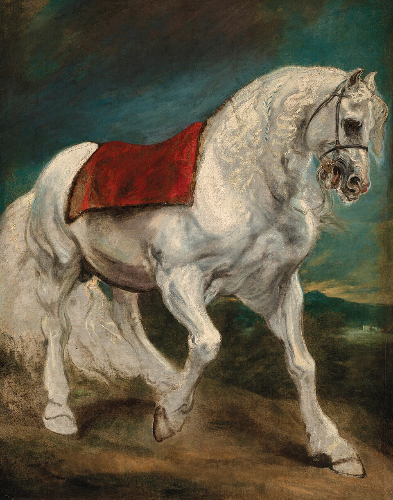
‘Destriers’ were the well-known knight’s horses. They were large and strong enough to carry knights in their armour, and were expected to look impressive. However, it is important to note that horses in the Middle Ages were generally somewhat smaller. It is not entirely clear how tall these animals were, but probably around 1.50–1.60.
Based on ancient depictions and archaeological finds, these horses would have most closely resembled modern Iberian breeds and perhaps some heavy warmblood breeds. Modern breeds that can be compared to them include, for example, Lipizzaners, Murgese and Kladrubers. One theory is that the destrier horses of that time were the ancestors of certain heavy draught horse breeds, such as Shires and Percherons. However, there is little evidence for this, and even if there were, it certainly does not mean that the ancient destriers looked the same as our modern draught horses. The same applies to the Friesian horse: although their medieval ancestors may have been used for this purpose, they did not resemble the ‘Friesian’ breed as described from the late 19th century onwards,
Destriers were, however, very expensive, which is partly why they were not particularly suitable as warhorses on the front line. They were better suited as show animals during tournaments and jousts.
Coursers
Coursers, on the other hand, were a more popular choice as warhorses. They were somewhat faster and lighter, and although they were still valuable animals, they were cheaper than a destrier. In addition, these horses were sometimes used as hunting horses. They probably resembled heavy warmbloods. Think of today’s Irish Draught/F1 Irish Hunters, Alt-Oldenburgers, East Frisians and Groningers.
Palfreys
Palfreys were luxury horses. Some were inexpensive, whilst others might have been so valuable that they were more expensive than a destrier. Whereas a destrier was meant to impress, a palfrey was meant to be admired. They were often somewhat lighter and more nobly built. Furthermore, it was important that palfreys were a comfortable ride. Palfreys therefore often possessed an additional, preferably four-beat gait (‘ambling’), probably similar or comparable to the tölt. That does not, however, mean that all gaited horses are descended from palfreys or resemble them, or that every gaited horse used to be a palfrey: an additional gait used to be quite common. Nowadays, this is no longer the case.
Horses of this type with Spanish blood were often called (Spanish) jennets, whilst the Irish had the ‘hobby’. As a fourth gait is quite rare nowadays, few modern breeds are truly comparable to the old palfreys. Paso Finos, Paso Peruanos and Mangalarga Marchadors may be comparable to the jennets.
Rounceys
The Rouncey was an all-rounder. They could be used as warhorses for the less wealthy cavalrymen, but also as packhorses. Less spectacular horses are also depicted less frequently. I’d guess that these looked something like a small Welsh cob, Highland pony, Icelandic horse, Fjord, or the like.
Afterwards
Other types of horse that were historically significant, both in and outside of medieval times, were simply working horses in the countryside. They were probably similar to Rounceys, though perhaps a bit sturdier and less agile. Then there was the ‘cob’, a type of working pony. Think of the Welsh Cob, Norman Cob and Irish Cob. This type probably overlapped with the Rouncey and the standard working horse.
Then there were carriage horses. This role has remained relevant until relatively recently. For this, you often needed good, sturdy horses that could preferably also work in the fields. Think here too of heavy warmbloods such as the Cleveland Bay, Nonius, Groninger, or look up some old historical pictures of the Gelderland horse. The Lipizzaner was, and remains, popular as a carriage horse too. The type of harness horse as we know them today (the modern Hackney and KWPN harness horses) emerged later.
Change
Over time, various breeds have emerged and subsequently become extinct. When a breed no longer served a purpose, often because a neighbouring region had horses better suited to the tasks or because innovation had rendered certain tasks obsolete, these breeds were often no longer bred but were crossbred with superior horses or simply replaced. Most breeds with a long history no longer look the same. Again, take the Friesian horse, for example: its ancestors looked more like a sturdy pony in the roman period, and a baroque type of horse in the 16-17th century. It subsequently evolved more into a allround, light draught horse in the early 20th century, just to return to a more luxury harness and riding type horse in the late 20th century. As a result, although the Friesian still clearly has Baroque influences, its characteristics as a harness horse and nowadays dressage horse are much more evident.
There are, however, breeds that still bear a strong resemblance to their historical ancestors. Think, in particular, of many sturdy European native pony breeds, where little breeding is done for sport. But also in Asia you’ll find breeds that have been bred in their current form for some time: certain lines of Arabians and Akhal-Tekes (Turkoman), Mongolian horses, Caspian horses, and so on.
Even now, there are still breeds that are slowly dying out, changing, or gradually re-emerging.
 Source: Anthony van Dyck, Public Domain, via Wikimedia Commons