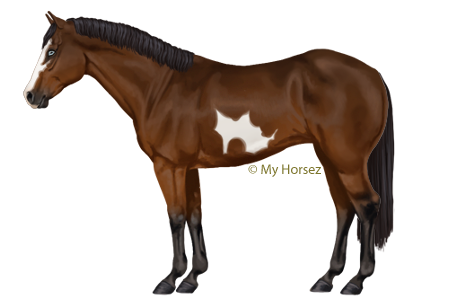
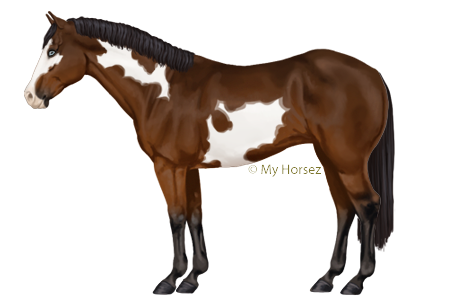
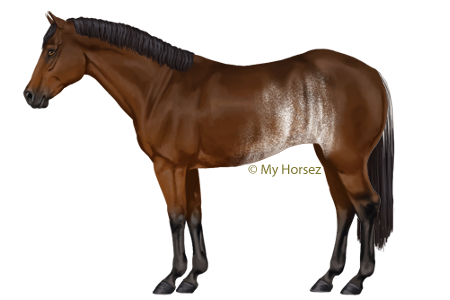
My Horsez - Wiki - Genetics (patterns)

Wiki » Breeding » Genetics (patterns)

Genetics

In Real Life, horses obtain their patterns through a combination of certain genes, each of which carries a particular trait. Because genes have different properties, many horses with special coat patterns can be found all over the world. On MH, a similar system is used based on Real Life pattern genetics, but in some cases adjusted to work specifically for the game.

Note: the information given here is an easy version, for easier understanding. In Real Life pattern genetics, may work differently than explained here. This explanation instead explains the genetics system used on MH.


White Patterns

Splashed White

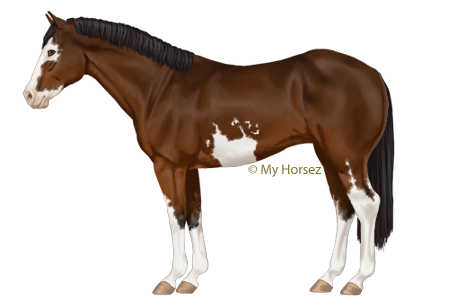
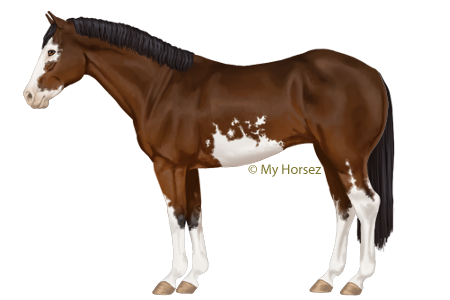
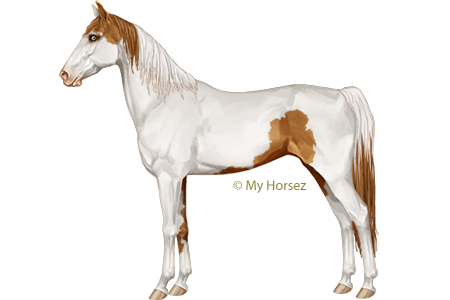
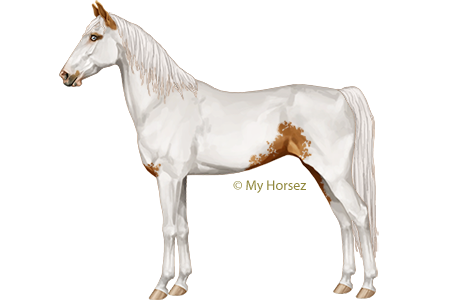
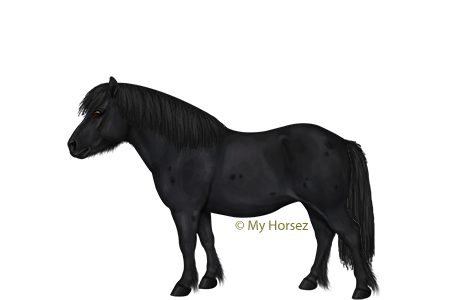
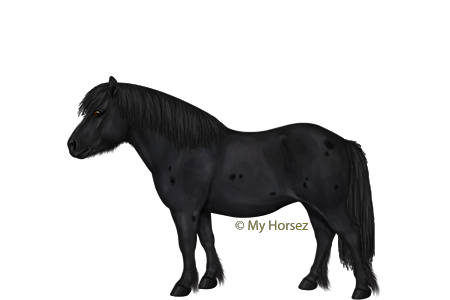
We have arrived at the first white pattern coat variant of this article: Splash (Spl). Splash is an allele which, when present 1x in real life, does not directly show. The horse does not have extremely high white markings on the legs and can have a small head marking. However, the horse may have a blue eye. The heterozygous (1 allele) presence of Splash is also known as "Hidden Splash". This is because the horse has splash, but does not show it or hardly shows it (a single blue eye is a possibly characteristic of Hidden Splash). With double presence, however, it is a completely different story; it seems as if the horse has been grabbed by the ears and dipped in white paint. The legs, head and often part of the tail are coloured white. Splash occurs on all colours and can occur in combination with other coat types. On MH, there are 2 types of Splash: type 1 and type 2. Splash 1 is visible when the horse has 1x splash, and type 2 is visible when the horse has 2 splash alleles.

Splash type 1: __/__/nSpl
Splash type 2: __/__/SplSpl

A Quarter Horse with the splash 1 pattern at online horse game My Horsez
Splash 1
A Quarter Horse with the splash 2 pattern at online horse game My Horsez
Splash 2

Note: As you can see, in the example, I have left everything blank except the Splash, so it does not matter what coat colour the horse has.
Further: see "Some interesting genotypes" for combinations with other white patterns.

Frame Overo

Another white patterned coat variant also common on MH is Frame, also called "Frame Overo". The code of this allele will also be "Fr" in this explanation. In Real Life, the dominant gene Frame expresses itself in varying amounts: minimal to maximal, but the white spots are always surrounded by the base coat colour ("framed in"). The spine of horses with Frame always remains dark, i.e. never white. Because Frame can express minimally, it is not always clear whether the horse has Frame or not. Double Frame is not possible in RL because of Overo Lethal White Syndrome. Foals with double Frame are born completely white, but die soon after birth. On MH, Frame is also a dominant gene, but double Frame is possible, and the foal will not die. Frame occurs on MH in 2 types: type 1 and type 2. Type 1 is caused by single presence of the gene, and type 2 is caused by double presence.

Type 1: __/__/nFr
Type 2: __/__/FrFr

A Quarter Horse with the frame 1pattern at online horse game My Horsez
Frame Overo 1
A Quarter Horse with the frame 2 pattern at online horse game My Horsez
Frame Overo 2

Note: As you can see, in the example genos I have left everything blank except Frame, so it does not matter what base colour the horse is.
Further: see "Some interesting genotypes" for combinations with other white patterns.

White Spotting - KIT

In my opinion, the KIT gene is an incredibly fun gene that causes many variations (alleles). Because there is a lot of variation, I will make the explanation as concise and clear as possible, because there is a lot to explain. On to the fun bit! KIT consists of multiple alleles that cause (white) patterns. As with any other gene, only 2 alleles on 1 locus are possible, allowing you to make some great combinations when the other coat patterns come into play, but.... which genes fall under KIT? See the list below:

Tobiano

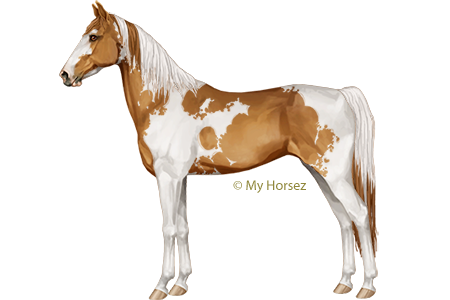
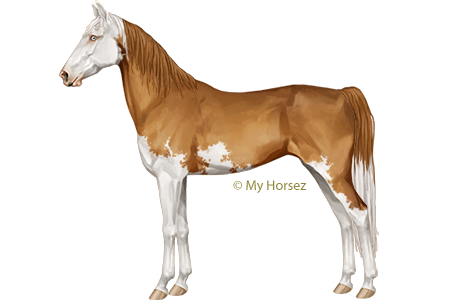
Tobiano is a dominant allele of KIT. This allele is denoted by code "T". Tobiano can be double present without being noticed, because there is no difference in single tobiano or double tobiano genotypes. However, this allele on MH does have multiple types, just like Splash and Frame. But unlike Frame and Splash, Tobiano type 1 can be combined with type 2, causing type 1+2 (and giving you three different tobiano patterns to enjoy!).

Tobiano type 1: __/__/nT1 or __/__/T1T1
Tobiano type 2: __/__/nT2 or __/__/T2T2
Tobiano type 1+2: __/__/T1T2
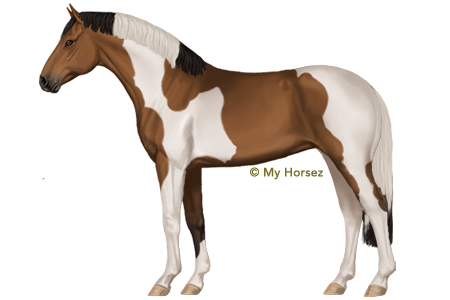
A Dutch Warmblood with the tobiano pattern at online horse game My Horsez
Tobiano 1
A Dutch Warmblood with the tobiano pattern at online horse game My Horsez
Tobiano 2
A Dutch Warmblood with the tobiano pattern at online horse game My Horsez
Tobiano 1+2


Sabino

Sabino is an incomplete dominant allele of the KIT gene. This allele is referred to by code "Sb". Sabino shows minimally in RL (Sabino1) when 1x present, but when present twice, almost the entire horse can turn white. On MH, however, Sabino is distributed somewhat differently and thereby also divided into different types: Type 1 (Sb1), Type 2 (Sb2) and Type 1+2 (Sb1Sb2). The 2 types can overlap here too, making the white increase.

Sabino type 1: __/__/nSb1 or __/__/Sb1Sb1
Sabino type 2: __/__/nSb2 or __/__/Sb2Sb2
Sabino type 1+2: __/__/Sb1Sb2
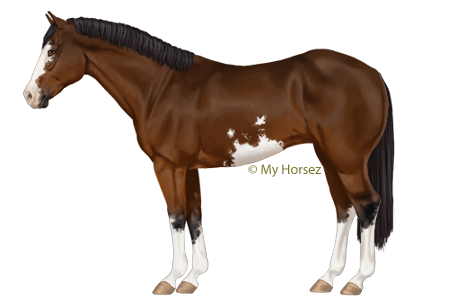
A Quarter Horse with the sabino 1 pattern at online horse game My Horsez
Sabino 1
A Quarter Horse with the sabino 2 pattern at online horse game My Horsez
Sabino 2
A Quarter Horse with the sabino pattern at online horse game My Horsez
Sabino 1+2

Note: As you can see, in the example, I have left everything blank except for the KIT genes, so it does not matter what base colour the horse is.
Further: see "Some interesting genotypes" for combinations with other white pattern types.

Dominant white

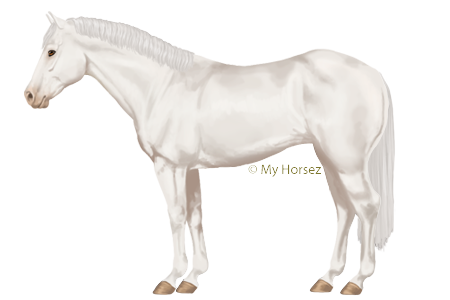
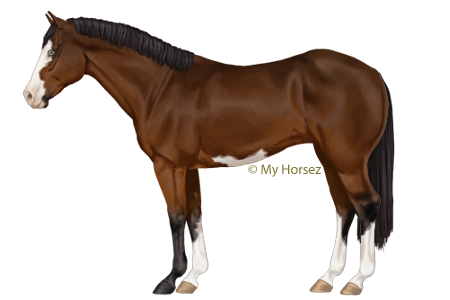
Another coat variant of KIT is the so-called Dominant White, denoted by code "Dw". Dominant White is a very sneaky factor on MH, given that it shows as the sabino 2 pattern when present 1x. So, it is always a question of whether the horse is sabino or Dominant White. When present twice, the Dw alleles cause the horse to be coloured all white or near white (depending on the breed). This is Dominant White type 2. Furthermore, this white pattern can occur on any coat colour, and completely white horses are also referred to by the colour they are underneath the white (as the white is considered a pattern).

Dominant white 1: __/__/nDw
Dominant white 2: __/__/DwDw
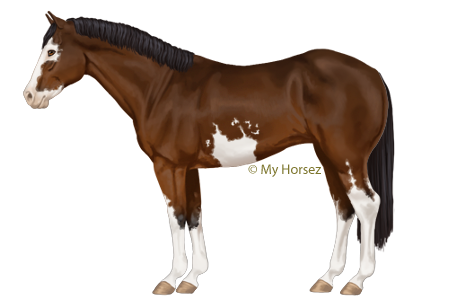
A Quarter Horse with the dominant white pattern at online horse game My Horsez
Dominant white 1
A Quarter Horse with the dominant white pattern at online horse game My Horsez
Dominant white 2

Note: There are also breeds on MH where Dominant White is "recessive". If the horse has 1x Dw, it will not show the Sabino 2 pattern, but nothing at all! Only if the horse has 2x Dw will the horse turn white. This happens, for example, in the Haflinger and the Icelandic horse.

Roan

Roan (Rn) is also a mutation on the KIT gene. Roan creates white hairs in the coat scattered over the body, but the head, legs, tail and mane remain untouched! Unlike grey, roan horses do not lighten as they age. This pattern shows on all colours and in combination with all other patterns. (Note that with KIT only 2 alleles can be present on 1 horse, so tobiano sabino roan for example is not possible, because that is 3 alleles instead of 2.) Roan is dominant and therefore already shows when 1x roan allele is present.

Roan: __/__/nRn or __/__/RnRn
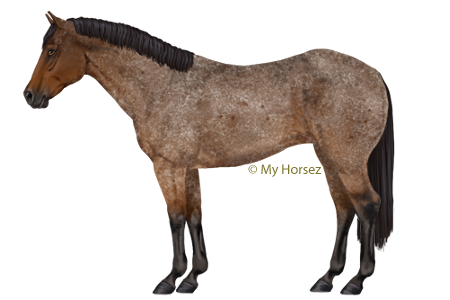
A Quarter Horse with the roan pattern at online horse game My Horsez
Roan


Rabicano

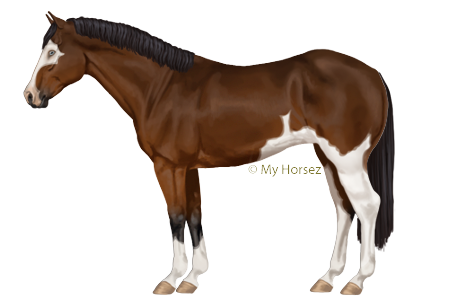
Rabicano causes a slight mixture of white hairs, often visible around the flanks and tail root. In real life, as with BS and BoS, it is not yet known how this marking originated and how it is inherited.

Whether a horse has one or two copies of rabicano makes no difference to the display. In both cases, rabicano is shown. The tail is also affected, usually with a lighter or “ticked” base, also known as a “skunk tail” or “coon tail”.
Appaloosa Coat Patterns

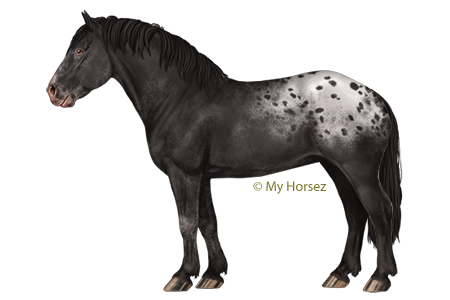
Appaloosa genetics are a bit more complex, but that is also what makes it very interesting. It is a big interplay of multiple loci and alleles that cause the different appaloosa patterns.

Leopard complex

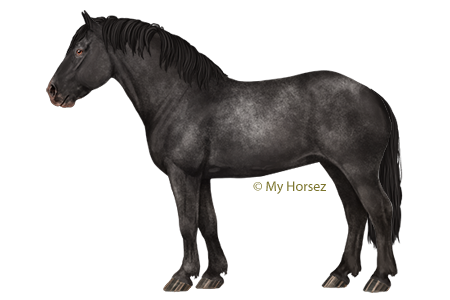
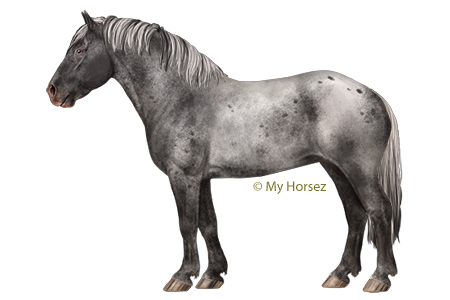
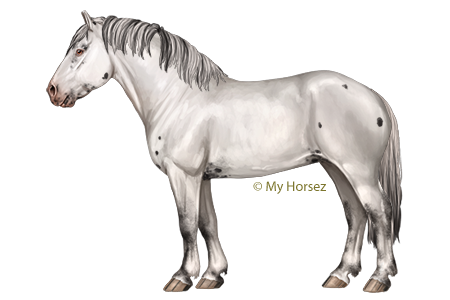
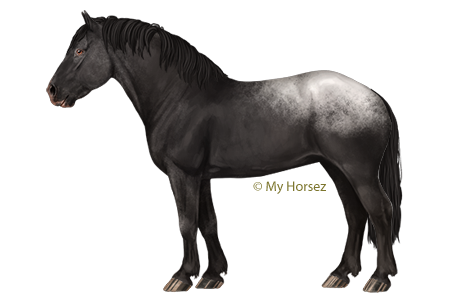
The first gene required in the recipe to "make" an appaloosa, is Leopard Complex. This gene is denoted by the code Lp. This Lp allele is the basis of the appaloosa patterns, because without this allele no appaloosa patterns are possible! So, the horse must carry the Lp allele at least once to show an appaloosa pattern. However, by itself, Leopard Complex does not cause traditional appaloosa patterns like leopard, but causes Varnish Roan or simply Varnish. This Varnish hardly shows at birth, perhaps a few white hairs in the coat. The horse also has the typical appaloosa features such as visible white of the eye, striped hooves and speckled skin. As the horse ages, it acquires more and more white hairs, until it becomes almost completely white. In this, it seems to work a bit like grey, but on the horse it looks more like a roan pattern. However, it is a completely different gene from the ones causing grey or roan. Furthermore, Leopard Complex is an incomplete dominant allele, so there is a difference in expression between single presence or double presence. This is mainly important for the appaloosa patterns besides Varnish, but we will come back to that in the Pattern genes. On MH, there are 2 types of Varnish: type 1 and type 2. Type 1 shows with single presence of the Lp allele, and type 2 with double presence.

Type 1: __/__/nLp
Type 2: __/__/LpLp

Soon to be added
Varnish 1
Soon to be added
Varnish 2


Pattern 1

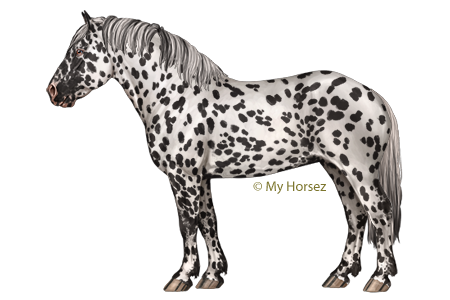
Pattern 1, coded Patn1, is a dominant allele located at a different locus from Leopard Complex. So, they are not part of the same gene like the KIT alleles. The only way to get an appaloosa pattern by Pattern 1 is in the presence of both Patn1 and the Leopard Complex allele. It can then produce two types of patterns: Leopard and Few Spot. Here, the importance lies with the Leopard Complex allele and not Pattern 1. So, it does not matter whether Patn1 is present 1x or 2x, but it does matter for Lp. When Lp is present 1x (in combination with Patn1 1x or 2x), it produces the Leopard pattern, and when Lp is present 2x, it produces the Few Spot pattern. So, it is the incomplete dominance of the Lp allele that produces the two patterns, but Pattern 1 must be present to show those two patterns at all. If a Patn1 allele is present but no Lp allele, then Patn1 has no effect and no pattern shows. If Lp is present but not Patn1, the horse will show as Varnish instead.

Leopard: __/__/nLp/nPatn1 or __/__/nLp/Patn1Patn1
Few Spot: __/__/LpLp/nPatn1 or __/__/LpLp/Patn1Patn1

Soon to be added
Leopard
Soon to be added
Few Spot


Pattern 2

Pattern 2 is the other appaloosa pattern gene, coded Patn2. Again, this allele is on a different locus and is therefore inherited separately from both Lp and Patn1. It works the same as Pattern 1, but then produces (again together with Lp present) the patterns Blanket and Snowcap. Blanket shows when 1x Lp is present, and Snowcap shows on double presence of Lp. Pattern 2 is a dominant gene in its own right, so it already shows when 1x present (as long as Lp is also present), but it is recessive to Pattern 1. So, if the horse has both Patn2 and Patn1, the Pattern 1 will dominate over Patn2. So, a horse with the Leopard pattern could have a genotype like this: __/__/nLp/nPatn1/Patn2Patn2. Patn1 is dominant over Patn2, so it shows the Leopard pattern instead of the Blanket pattern.

Blanket: __/__/nLp/nPatn2 or __/__/nLp/Patn2Patn2
Snowcap: __/__/LpLp/nPatn2 or __/__/LpLp/Patn2Patn2

Soon to be added
Blanket
Soon to be added
Snowcap

Some interesting genotypes

Of course, white coat patterns and different dilution genes also appear in combinations, allowing you to develop exceptionally fun and interesting variations. This is possible both in real life and on MH, and in this game everything will be kept as realistic as possible. Especially KIT is quite often misunderstood, but here you will definitely get an insight with the help of some interesting genotypes!

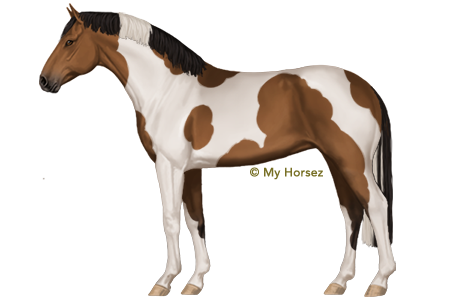
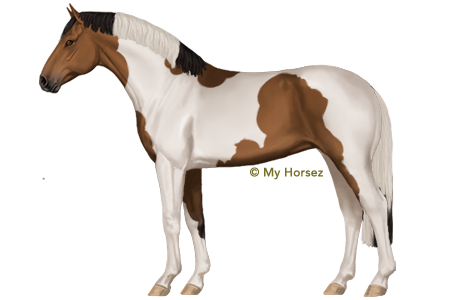
Sabino Tobiano & Splash Sabino

Sabino and tobiano are, as explained earlier, both KIT alleles. On KIT (and every other locus actually) only 2 alleles exist. So, this sabino tobiano chestnut American Saddlebred has the following genotype: ee/__/SbT. "SbT" should be read as Sabino (Sb) and Tobiano (T). As you can see here, the KIT now has 2 alleles, and nothing more can be added. So Sabino Tobiano Roan (3 KIT alleles) is not possible, because a horse only gets 1 KIT allele from its mother and 1 KIT allele from its father, and together those are 2! Splash Sabino is a combination of a non-KIT pattern and a KIT pattern: ee/__/Spl_/Sb_. The horse can have 2x splash and 2x sabino, but that won't make a difference, the pattern shown will also be Splash Sabino (since the alleles are not incomplete dominant). Here you see Sabino Tobiano and Splash Sabino alongside each other. Can you see that Sabino gives the normally tightly drawn spots a jagged edge all over? That is a characteristic of double pattern in which sabino is mixed in!

American Saddlebred with sabino and tobiano pattern at online horse game My Horsez
Sabino tobiano
American Saddlebred with sabino and splash pattern at online horse game My Horsez
Splash sabino


Frame Sabino Tobiano & Tobiano Frame Splash

Although 3 KIT alleles together are not possible, it is possible to combine Frame and Splash! Here I show 2 genotypes with 3 alleles on chestnut American Saddlebreds, because these patterns also give you the best insight. The first is the Frame Sabino Tobiano with the genotype as follows: ee/__/nFr/SbT. "Fr" is written seperately from the SbT because the Frame allele is part of a different locus (the Frame locus) than the KIT locus (SbT). And because Sabino and Tobiano are both part of the KIT locus, they are written together as "SbT". The second pattern is Tobiano Frame Splash, and here there is something a little different from the previous two. The genotype for this coat pattern on chestnut is the following: ee/__/nFr/Spl_/nT. Possibly the horse could also have 2x T, so double tobiano, but that makes no difference to what pattern shows on the horse. Now again you have 3 pattern alleles, but as you can see only 1 of the 3 is a KIT allele! Can you add roan or sabino? Yes, as long as there is a vacant spot at the KIT gene! It could then become Tobiano Sabino Frame Splash, for example; ee/__/nFr/nSpl/SbT, 4 colours together!

American Saddlebred with tobiano, frame and sabino pattern at online horse game My Horsez
Frame sabino tobiano
American Saddlebred with tobiano, frame and splash pattern at online horse game My Horsez
Tobiano frame splash

American Saddlebred with tobiano, sabino, frame and splash pattern at online horse game My Horsez
Tobiano sabino frame splash


Birdcatcher Spots en Bend or Spots


Birdcatcher Spots and Bend or Spots are likely caused by a genetic mutation. It is not yet known in real life how these originated or how they are inherited. It is known that both mutations occur more frequently in certain lines, which could indicate a genetic link.

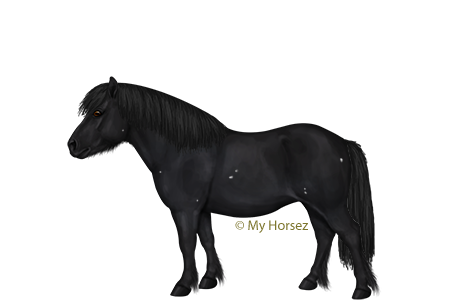
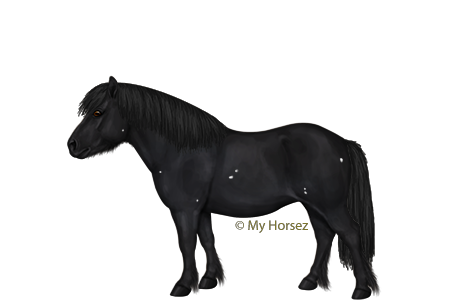
Birdcatcher Spots are often small, white spots that appear and disappear with age or due to other factors. Bend or Spots are usually small to medium-sized, dark spots that are clearly visible on a lighter coat.

In game, Birdcatcher Spots (BS) and Bend or Spots (BoS) work the same as Roan, for example. Both BS and BoS are dominant, meaning that they are expressed even when only one is present. For the sake of explanation, we will refer to the Birdcatcher Spot allele as ‘BS’ and the Bend or Spots allele as ‘BoS’.

Birdcatcher Spots:__/__/nBS or __/__/BSBS

Bend or Spots:__/__/nBoS or __/__/BoSBoS

When a horse carries BS or BoS twice, the effect is sometimes slightly more visible than with one copy, but the difference is subtle. These patterns can occur on all colours and also in combination with all patterns.


Birdcatcher spots __/__/nBS

Birdcatcher spots __/__//BSBS


Bend or Spots __/__/nBoS

Bend or Spots __/__//BoSBoS


Patterns - variants

The already existing white patterns can come in three different variants for every breed (Irish Cob, Hannoverian & Welsh Cob). All these different variants are still part of the general pattern (for example, Tobiano 1), but the white markings will look slightly different in every variant (version 1, 2 & 3). A line could take a slightly different path, a leg could have more white or a blotch could be bigger or in a different spot. Variant 1 of a pattern is the dominant version and was previously the only variant of the pattern.

For most patterns there are 3 variants per pattern. However, the Appaloosa white patterns have 2 variants.

How do you breed a specific variant?

To make it a bit easier we’ll be using abbreviations for the variants: variant 1 = v1, variant 2= v2 and variant 3 = v3.

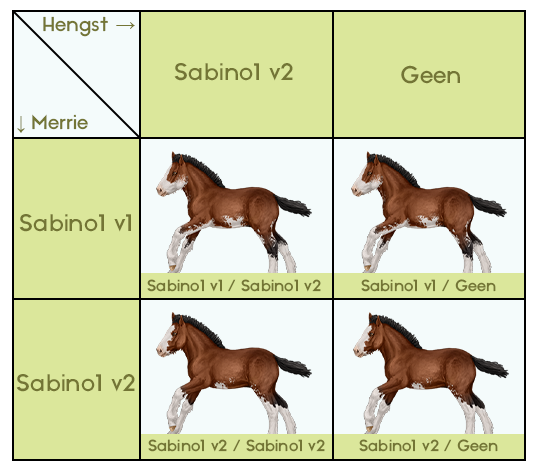
The variant with the lowest number (v1) is dominant. So if you want to breed a type 1 v2 horse, you need to make sure that both the mare and the stallion carry at least 1x type 1 v2. If a horse has at least 1x type 1 v2 it is a carrier. A carrier has a 50% chance of giving this gene to its foal. If both the mare and the stallion have two copies of the type 1 v2 gene, the foal is guaranteed to inherit one copy from each parent and will therefore also have two copies of the gene, making the foal a guaranteed type 1 v2.
Imagine you have a mare that has v1 + v2 and a stallion that has v2 + none. In this case, the mare shows v1, but is carrier of v2 so she can pass it onto her foal.

Another example. Imagine you have a horse that has v2 + v3, then it will show v2. If you have a mare that has v2 + v3 and a stallion that has v2 + none. The mare shows the v2, but is carrier of v3 and can pass this onto her foal.

If you want to breed combined patterns it becomes a bit more challenging. If you want to breed a tobiano splash v3, both the tobiano-gen as well as the splash-gen need to be v3. The lowest numbered variant is dominant. This means that higher numbered variants (v2 and v3) are more difficult to breed.

Examples:
  • Sabino type 1 v1 + none = Appears as Sabino type 1 v1
  • Sabino type 1 v2 + none = Appears as Sabino type 1 v2
  • Sabino type 1 v3 + none = Appears as Sabino type 1 v3
  • Sabino type 1 v1 + Sabino type 1 v2 = Appears as Sabino type 1 v1
  • Sabino type 1 v1 + Sabino type 1 v3 = Appears as Sabino type 1 v1
  • Sabino type 1 v2 + Sabino type 1 v2 = Appears as Sabino type 1 v2
  • Sabino type 1 v2 + Sabino type 1 v3 = Appears as Sabino type 1 v2
  • Sabino type 1 v3 + Sabino type 1 v3 = Appears as Sabino type 1 v3


Exceptions

Splash

If a horse carries 1x splash (heterozygote) it will look just slightly different than when a horse carries 2x splash (homozygote).

Imagine a horse carries splash v1 + splash v2. This horse will look like a homozygous splash v1. Imagine a horse carries splash v2 + splash v2. This horse will look like a homozygous splash v2.

Dominant White

The dominant white gen, just like the splash gen, works a little differently. A heterozygous horse (a horse carrying 1x dominant white) will look like sabino type 2. Which variant it is depends on the dominant white gene (v1, v2 or v3). That means that a homozygous horse carries the dominant white gene twice. Therefore if you want to breed a dominant white v2 horse, that horse has to carry 2x dominant white v2.


Authors

This handy gene explanation was written by Sharkbait and adapted by EmmaVZ.
The piece on appaloosa and mushroom were written by EmmaVZ.

You are currently visiting the website of online horse game My Horsez!